





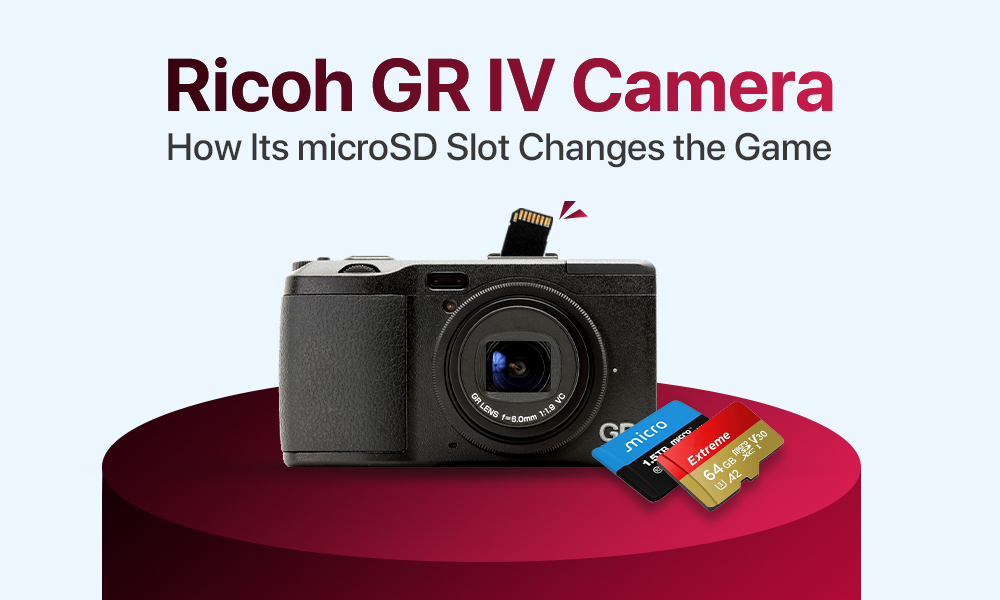
The Ricoh GR series has earned a loyal following for its pocket size, sharp 28 mm lens, and no-nonsense controls.
Below is a clear look at what the GR IV brings, why the microSD change matters, how it stacks up against rivals, and who will get the most from it.
A quick look at the GR legacy
From the first digital GR to the GR III and GR IIIx, the series has focused on image quality, fast response, and a design that stays out of your way. You get an APS-C sensor and a bright, sharp prime. The controls feel predictable. The body slips into a jacket pocket. Phones keep getting better, yet the GR line keeps its place because it delivers a clean, high-resolution file with very little fuss. That is why it lives in so many everyday bags.
The microSD slot and why it matters
Most compact cameras in this class use full-size SD. Ricoh chose microSD for the GR IV. That may sound small, but the daily impact is real.
Lower cost for more space
MicroSD cards are widely used in phones, action cams, and handheld consoles. That scale keeps prices down. You can buy quality 256 GB to 1 TB microSD cards for less than many full-size SD options. If you shoot RAW, the savings add up.
Easier to carry backups
A tiny plastic case holds several microSD cards. Toss it in a coin pocket and you are covered for a week. Travelers can carry multiple sets without weight or bulk. If you shoot all day, you can rotate cards and leave one in the hotel safe.
Flexible with other devices
A microSD card slides into a phone or tablet through a small USB-C reader. That makes edits and backups simple when you are away from a laptop. You can review a day’s work on a bigger screen, upload selects to the cloud, and share faster.
Speeds that match the use case
The slot is UHS-I. That is fast enough for burst RAW on a street camera and more than enough for 1080p clips. If you need extreme buffer clear rates for pro video, you are likely shopping in a different category anyway. For the GR IV’s purpose, UHS-I is a balanced pick that keeps costs down.
A few habits to adopt
MicroSD cards are small. Use a labeled, latch-close card case. Always format in camera after backup. Keep one extra card and a tiny USB-C reader in your bag. With those habits, you get the benefits with none of the stress.
A small change with a big workflow impact
Camera reviews often focus on sensors and lenses, but storage choices shape how a camera is actually used. The move to microSD shifts the GR IV closer to how people already work in 2026.
MicroSD cards are familiar. Many photographers already use them in phones, action cameras, drones, and handheld devices. That familiarity removes friction. You do not need special card wallets or bulky readers. A tiny USB-C reader and a phone are enough to review, back up, and share images almost anywhere.
For street photographers, this matters more than raw specs. When the barrier between shooting and reviewing gets smaller, the camera feels more present in daily life rather than something that waits at home for planned shoots.
Cost and convenience over the long term
One of the quiet benefits of microSD is cost. High-quality microSD cards are produced in massive volumes, which keeps prices lower than many full-size SD cards. Over time, this reduces the cost of ownership.
Instead of buying one large card and hoping it never fails, you can afford to carry several medium-capacity cards. Rotating cards by day or location becomes easy. If one card goes missing or develops an issue, the loss is limited.
This approach fits the GR philosophy well. The camera is built to be used often and carried everywhere. Storage should support that mindset rather than add anxiety.
Internal memory as a safety net
The 53 GB of internal storage on the GR IV does not replace removable cards, but it changes how relaxed you can be. Forget a card at home and you can still shoot. Fill a card mid-day and you have a place to keep going. Pick a few favorite frames and store them internally as an extra copy before backing up.
This kind of redundancy is not about disaster planning. It is about removing small points of stress that interrupt the flow of shooting. When the camera feels forgiving, you are more likely to take it out more often.
How the GR IV fits modern phone-based workflows
In 2026, many photographers edit and share directly from their phones. The GR IV’s microSD slot works naturally with that reality.
Pop the card into a phone with a small reader, cull images on a larger screen, apply light edits, and post or back up before you even get home. You do not need to power on the camera again or drain its battery transferring files. The process feels closer to using a notebook than managing gear.
For bloggers, travelers, and creators who publish frequently, this ease of movement matters as much as image quality.
Who will feel the biggest difference
The microSD decision will resonate most with photographers who value flexibility over formality.
Street and documentary shooters benefit from lighter carry, cheaper backups, and fast phone-based sharing. Travel photographers gain an easier way to rotate cards and back up while moving between places. Professionals who already own larger systems get a pocketable companion that integrates cleanly into a modern workflow.
If your priorities include long-form video, a built-in viewfinder, or higher-end codecs, there are better tools for that job. The GR IV is focused and honest about what it wants to be.
Image quality and handling
The new sensor brings a modest bump in resolution and better dynamic range. Files grade well, with a clean look at base ISO and usable detail at higher ISOs for night scenes. The revised lens keeps the GR signature: crisp center, strong corners, and nice contrast. Autofocus is faster in low light. Focus acquisition on faces and small subjects is more reliable than before.
The stabilizer adds confidence for hand-held shooting at slower speeds. You can work at dusk without pushing ISO as hard. The grip and body texture feel secure. The touchscreen speeds up menu moves and AF point selection, and the custom buttons keep your most used settings on top.
Suggested card sizes and setups
Ricoh supports microSDXC at high capacities. Match your card to how you shoot.
- Casual everyday use: One 128 GB card. Room for hundreds of RAW files and lots of JPEGs.
- Weekend trips: Two 256 GB cards. Rotate daily and keep one backed up to your phone or tablet.
- Long travel or heavy RAW: Two 512 GB cards or a single 1 TB with a spare 256 GB as a safety. Use the internal memory as a temporary second copy for selects.
Look for A2 UHS-I V30 cards from known brands. You get solid sustained performance and quick app-like file access for phones and tablets.
Everyday workflows that fit the GR IV
Street day with quick posting. Shoot RAW+JPEG. Use JPEG for instant share, keep RAW for later edits. End of day, use a phone to select ten favorites, apply a light grade, and post.
Travel loop with backup. At dinner, back up the day’s card to a phone or tablet, then to a small SSD if you carry one. Format the card in camera after verifying the copy. Use the internal memory to hold the best five frames as an extra safety.
Personal project or zine. Shoot one card per chapter or neighborhood. Label cards by date and place. This makes culling and sequencing easier later.
Tips to keep cards and files safe
- Buy from trusted sellers: Counterfeit cards look real and fail early.
- Test new cards: Fill them once at home and copy everything off to confirm speed and stability.
- Format in camera: After backup and verification, format in the GR IV to keep the file system clean.
- Use a small latch case: Label slots by day or location.
- Keep one extra card and one USB-C reader with the camera: This solves most storage emergencies on the road.
- Back up twice on longer trips: Phone or tablet, plus a small SSD if you have one.
Who should buy the GR IV
Street photographers: You get stealth, fast focus, a sharp 28 mm, and a body that never feels like a burden. The microSD flow fits how you move through a city.
Travel and urban shooters: You can pack light, carry spare cards without thinking, and keep posting while away from a desk.
Creators and bloggers: The mix of internal memory and microSD makes hand-held backup simple. Short video clips and stills move easily to a phone for quick edits.
Pros who want a pocket sidekick: Your main kit may be a full frame setup, yet the GR IV can live in your pocket for scouting, behind-the-scenes, and personal notes. The files hold up and the workflow is painless.
If you need a viewfinder, an alternative focal length, or higher video specs, look at the Fuji X100 line or a compact full-frame. If you want a pure stills tool that partners with a phone and never slows you down, the GR IV fits.
Frequently Asked Questions
Yes for the GR IV’s purpose. Burst RAW and 1080p clips are handled well with a quality V30 microSD card. For cinema work at extreme bitrates, you would use a different camera class.
They will, but you should use modern A2 UHS-I cards for reliable sustained writes and faster app-style access on phones.
Use a small labeled case and form a habit. Swap cards only over a table or open bag. Done this way, the risk is low.
Treat it as a safety buffer. Use it when a card fills, when you forget a card, or to hold selects as a second copy until you back up.
Yes. A simple microSD-to-SD adapter works for most computers and cameras that take full-size SD in a pinch. For fastest transfers to phones and laptops, a USB-C microSD reader is better.
